Showing posts with label USA. Show all posts

Thursday, August 27, 2020

Research paper

Earlier this week, I finished my fifth class for my master's degree. While I received an A in the class, my final assignment was left out. Apparently, my professor got confused on when final grades were due and didn't have time to grade the final (which was originally worth 20% of the grade), so she dropped it from her scoring rubric.

Cool.

Well, since I took the time to write a 2200+ word research paper and now it has no audience, I've decided to share it here. Don't feel obligated to read it, but if you, I'd love to know what you think.


Hate Speech vs. Censorship: The Power of Language on Social Media and the Dangers of Both Hate Speech and Censorship

Free speech is often held as the most vital liberty protected by the Bill of Rights. Yet, is it possible to maintain the freedom of speech while still limiting it? Specifically, how can free speech be protected while still preventing hate speech, especially on social media? The crux of this dilemma is that taking action to curb hate speech is a form of censorship, which inherently hinders free speech. However, with the rise of social media platforms being used as a new outlet for individuals and groups to use hateful language—and new hate groups forming and made possible via social media platforms—there is growing concern about the dangers of allowing hate speech to exist unrestrained. Ultimately, the question becomes: is controlling hate speech on social media worth the price of censorship? This paper will explore this issue by defining hate speech, providing a brief history of hate speech in the US, establishing the existence of hate speech online and on social media, defining free speech as it exists in the US, supplying evidence of the power of hate speech, and establishing the view of censorship by the US Supreme Court. The goal of this paper is to weigh the dangers of hate speech against the dangers of censorship, offer an opinion about which is more perilous, and provide potential options of how to best address these concerns.

Identifying the Issue

There is no official, legal term for what constitutes hate speech in the US; however, according to the UN, "the term hate speech is understood as any kind of communication in speech, writing or behaviour [sic], that attacks or uses pejorative or discriminatory language with reference to a person or a group on the basis of who they are, in other words, based on their religion, ethnicity, nationality, race, colour [sic], descent, gender or other identity factor." To put it another way, hate speech is biased and insidious language used to attack a person or groups of person based on one or more thing that make up that person’s identity. In this way, hate speech is different from disagreeing with a person's opinion, viewpoint, or ideology. Hate speech is used not to attack philosophies, but people themselves.

History of hate speech in the US

No history of hate speech in the US would be complete nor honest without first discussing the nation’s history of race-based slavery. The American colonies and later the fledgling US were established with race-based slavery. While slavery and indentured servitude had been used around the world for centuries, the version of slavery in America was different in that it was lifelong and based on parentage. Even in the early colonies, children born to slaves were free. With the modification to make only one racial group enslaved, many whites in the South, whether slaveowners or not, viewed black persons merely as property and not as people. Language evolved to convey this derogatory view "and no word conveyed the depth of this internalized oppression more than [the N word]." While hateful, derogatory labels have existed well before the New World was discovered by Europeans and have been used to describe other groups beyond those of African heritage, the fact is that US slavery being race-based made a huge impact on how a specific racial group was seen and treated.

After slavery ended, hate groups, the Ku Klux Klan (KKK) in particular, were established not only to speak against (and harass and physically attack) the freedoms newly freed blacks enjoyed, but also against black persons themselves. Additionally, the KKK was vocally and physically violent against Catholic and Jewish persons, as well as other groups. The KKK is simply one example of a hate group that arose to attack—verbal, physically, or both—individuals based on one or more "identity factor."

This paper is not suggesting that only black persons have been persecuted based on identity factors in the US. Sadly, there are many groups that have had hate speech hurled and acts of violence committed against them—Jews, Mormons, Latinx, Japanese Americans, Native Americans, Irish, LGBT, and so on—more than can be mentioned here. The example of black persecution laid out above is meant merely to be a single instance of a group well-known to encounter hate speech and other hateful acts.

Hate speech online and on social media

In the second chapter of her book Hate Crimes in Cyberspace, Danielle Keats Citron explores what it is about the Internet that seems to promote hate speech. "Some of the Internet's key features—anonymity, mobilization of groups, and group polarization—make it more likely that people will act destructively." Citron offered two examples of hate speech directed towards Sports Illustrated writer Jeff Pearlman. In both cases, Pearlman tracked down his attackers and confronted them about their vitriolic comments. Each individual was shocked by the confrontation and admitted their embarrassment, suggesting that "the internet got the best of [them]."

Since the introduction of social media platforms, groups have been able to form based on shared interests or identity factors. While this has been wonderful for niche and marginalized groups, it has also proven to be a fertile breeding ground for hate groups. Prior to his attack of a Pittsburgh synagogue and killing eleven, accused attacker Robert Bowers used the defunct social media platform Gab to share his anti-Semitic views. Prior to Gab’s infrastructure collapsing, the platform had been a favorite meeting place of white supremacists. Had Gab not enabled these hate groups to gather, could the Pittsburgh shooting have been avoided?

Definition of free speech

The first amendment of the US Constitution states that "Congress shall make no law… abridging the freedom of speech, or of the press…". This amendment serves as the basis for free speech laws throughout the country, though it should be noted that private (or even publicly traded) companies are not prevented from enacting their own limits of speech. Also, the First Amendment does not provide any protection towards citizens who exercise their freedom of speech and suffer consequences from doing so, e.g., getting fired for making insensitive remarks. For the past seven decades, when the US Supreme Court is asked to rule on a case where the freedom of speech is a factor, the judicial body has shown that it is very likely to come down in favor of the First Amendment. This is significant as it illustrates the high level of importance assigned to free speech by the US federal government.

Three components that make this an ethical problem

Polarization

One reason hate speech is so alarming is because it is such a powerful tool. Hate groups are able to provoke violent actions in their members—nearly all recent mass shootings have been motivated by hatred. This type of radicalization makes hate groups dangerous, and not just towards the objects of their hate. "'It wasn't any one group—I hated everyone,' [former white supremacist Frank] Meeink remembers."

Dehumanization of victims

Referring to the men’s rights movement Reddit group r/Redpill, writer J. F. Sargent breaks down how they view the object of their hatred: women. "Women are commodities to be acquired and subjugated. They are conquests—things that determine your worth as a human." Viewing objects of hate as subhuman is common for hate groups.

Censorship

Despite his many, many flaws, President Trump signed an executive order to prevent online censorship, which should be commended. However, less than two months later, Trump issued another executive order effectively banning the social media platform TikTok, a move many see as a form of censorship. As stated previously, the US Supreme Court holds free speech in high regard. The US was founded by a group who felt their voices were not being heard ("no taxation without representation"), so silencing any individual's or group's voice should be taken very seriously.

Management of the Issue

Clearly there is a problem with hate speech on social media, but how can it be addressed? Following are some recommendations.

Let platforms govern themselves

Platforms have already started policing hate speech, though some better than others. Famously, Facebook announced last year that it had created a managing board to judge whether flagged content could remain up or would need to be taken down. The system is not perfect, but the company is taking steps to control hate speech, as well as misinformation. Other platforms have also put in place their own guidelines, with Reddit's as a standout for how much freedom is allowed. However, this approach leaves the decision of what to allow and how to act in the hands of the platforms. What if the restrictions are too tight, not allowing users to share information freely? Conversely, what if the restrictions are too loose, permitting violent breeding grounds as was seen with Gab?

Follow Europe's lead

In 2008, the European Union passed legislation which stated "that hate speech would be sanctioned and punitive measures could be taken against individuals or groups engaged in hate speech." Laws like this create incentive to not engage in hateful speech. However, it also makes speaking one’s mind a potentially criminal offense. Add to that the fact that a similar law in the US would likely require a constitutional amendment, what is the likelihood of a law of this nature being passed in the increasingly polarized and tribalist congress?

Expand Defamation Laws

If we cannot trust social media platforms to police themselves and we cannot expect a criminal law to be created, perhaps the best route is to apply defamation law. Defamation is "a false statement presented as a fact that causes injury or damage to the character of the person it is about." By allowing defamation to encompass hate speech—including hate speech online and on social media—those who are the subject of hate speech would have a legal path through which to seek damages from their attacker, while those who wish to continue to engage in hate speech are free to do so without fear of being prosecuted by the state. The burden of proof would rest on the plaintiff, which would require a standard definition of hate speech. Additionally, social media platforms would no longer be held responsible for what their users say—similar to how email services are not sued for allowing an unsavory letter to be delivered.

Foreseeing Oversights

Even though the proposed expansion of defamation law seems like the best fit considering US laws, such a law’s introduction will likely bring with it new challenges.

Different Laws in Each State

Since defamation laws differ from state to state, each state would need to pass their own version. That does mean that some states will likely have stricter laws than others, which can make it challenging when both parties live in different states.

Legal loopholes

When drafting the new laws, legislators—whether through overzealousness, malicious negligence, or merely unseen omissions—may use wording that is either too ambiguous or too narrow-sighted. If this happens, it may allow for some crafty attorney in the future to have the suit dismissed, despite their client actually being responsible.

Frivolous Suits

The US has been accused of being a "sue happy" nation, so what is stopping an annoyed and/or money hungry individual from accusing an innocent person of defamation and bringing suit against them?

Responses and Application

Different Laws in Each State: Use Divorce Law as the Guide

One solution could be for the expanded defamation laws to work similar to divorce laws, i.e., the plaintiff decides in which state they want to file their suit, the state in which they live or the state in which the defendant lives. Another issue is when different states adopt different definitions of hate speech, but that can be addressed by using the definition in the state wherein the plaintiff files suit.

Legal Loopholes: Close Them over Time

Legal loopholes are almost certainly going to arise and the way to address them will be the same way legal loopholes are addressed now: to close the loopholes as they are discovered. Legislators will need to be careful with their wording as they draft the new laws and they, and concerned citizens, will need to watch closely for when unclear wording is abused. When this happens, it is time campaign for changes to the law.

Frivolous Suits: Innocent until Proven Guilty

Since the burden of proof is on the plaintiff, the defendant is innocent until proven otherwise. There are people who use current laws to bring forth frivolous defamation suits, but these are mostly thrown out. The difference with the current law and this proposed law is that, with regard to hate speech, no proof of suffering will be required, simply proof that the defendant engaged in hate speech directed at the plaintiff or a group with which the plaintiff identifies.

As this paper has explicitly detailed, hate speech is a powerful weapon that in some cases has resulted in the loss of human lives. With social media, that hatred is shared much faster and farther than ever before. Clearly something must be done, while still protecting free speech. By expanding defamation law, the ability to combat hate speech is given directly to those who are its target, giving power to those who were before merely victims.

Monday, November 14, 2016

Results

So, Donald Trump is the new president.  You may recall that I predicted that this very thing would never happen.  I’m mature enough to admit that I was wrong, though that’s not the purpose of this post.  Instead, I’d like to offer my thoughts about the recent election, including the results.

First, as I already mentioned, I didn’t support either candidate.  I felt that both Donald Trump and Hilary Clinton were bad choices, so I voted for someone who I believed would do the best job, despite knowing that he had no real chance of succeeding.  I feel good about my decision and I’m glad that I voted the way that I did.

Second, I was surprised that Trump won.  Polls showed Clinton as the leader, though by a narrow margin.  In addition to the polls, most media outlets mocked the Trump campaign and his supporters, leading many people—including me—to believe that while the election would be close, Clinton would be the victor.  When Trump won, I think we were all caught off guard. However, that’s actually a bit inspiring.  My boss, Magda, is originally from Poland and spent several years in Mexico.  She’s seen her share of rigged elections and she thought that Trump’s success proved that the American election process was honest.  As she put it, “It shows that the system works.”  Despite my lack of support for the president-elect, I must admit that her words do give me hope.

Third, I think I understand where Trump supporters are coming from.  When I served my mission in northern Ohio, I spent the majority of my time in more rural areas.  I remember one town in particular that had once been a manufacturing hub with four different plants.  By the time I visited, three of the plants had shut down and the third had slowed production.  The town was dying and the residents didn’t know how to cope.  I also remember meeting farmers who were using old, outdated equipment because, despite receiving government subsidies, they couldn’t afford to replace anything.  Most (if not all) of Obama’s policies benefited the working poor and middle class in cities, not the country.  After eight years of a president who they felt was ignoring them, the people who didn’t live in a major city wanted someone very different.  While Trump certainly had supporters in urban communities, the majority of his success was with people out in the country.

Fourth, protests are happening in cities across the US because of Trump’s surprise victory.  But what’s the end goal of those involved?  This isn’t like other recent protests such as those condemning police brutality—in those cases, the protestors wanted to be treated better by police, something that should happen anyway. With the case of the new president-elect, the protestors are complaining about not getting their way.  Besides that, Trump isn’t even president yet.  He’s been elected, but he won’t be sworn in until early next year.  Even if we don’t trust Trump, can’t we at least give our fellow Americans the benefit of the doubt for choosing him?  And even if we can’t there’s nothing that can be done at this point.  If he’s a bad president, he can be impeached, but there is no constitutional way to prevent him from taking office come January.

Finally, I was disappointed by how little respect Trump supporters got from the media.  Not the man himself—Trump makes himself an easy target for ridicule—but the citizens who attended his rallies and put his signs in their front yards.  They were depicted as dumb hicks and religious zealots who were too stupid to be reasoned with.  The fact that they were mocked so much may have had a hand in the election’s outcome.  While I haven’t heard of anyone saying that they voted for Trump as a way of protesting this mockery, I’m sure that at the very least it kept them from considering Clinton.  I imagine one of these people watching Saturday Night Live, Last Week Tonight, or even The Tonight Show and hearing something to the equivalent of “Are you thinking about voting for Trump?  Here’s a list of ways that you’re stupid.”  That kind of rhetoric isn’t going to convince anyone that isn’t already on your side.

I do like some of the things I’ve seen (mostly on Facebook) where people are sharing the sentiment that we need to unite as a citizenry and respect each other and the way we voted.  I didn’t vote for Trump and I don’t care for the man or his politics, but I believe in this country.  America is not a bunch of rules and documents; it’s people who believe in each other and those who have gone before us.  I believe in America and I hope that the rest of my brothers and sister in this, the greatest nation in the world, can share that faith with me.

Tuesday, November 8, 2016

Poll Dancer

Today, I exercised my civic responsibility and voted.  It was not only my first time voting in Maryland, it was my first time voting outside of California.

The polling place I was assigned to was a local Shriner's temple.  After a bit of confusion on which room I was assigned (I was in the clubhouse, not the dining hall), I had my ballot.  In addition to voting for Evan McMullin as a write-in presidential candidate, I voted on local matters, nearly all of which entailed Baltimore County borrowing money for civic works projects.

As I was leaving, I saw a mother with her daughter outside selling Girl Scout cookies.  I was impressed with the cleverness of their location choice ("Feeling awful about the election?  Drown your sorrows in sugar!"), so I bought a couple of boxes to share with the office.

To my surprise, I was feeling anxious as I drove to the polling place.  I didn't know why I was feeling that way, but as I drove away feeling relieved, it was clear what the cause was.  This election cycle has been terrible in so many ways and I'm just glad it's over.

Hopefully our country is strong enough to withstand whichever deplorable person makes it to the White House.  Fingers crossed!

Friday, October 14, 2016

Three's a Party

I've been working really hard to figure out who I should vote for this presidential election.  One the one hand, Hilary Clinton is a criminal with plans that will ruin our country, while on the other hand, Donald Trump is a criminal with plans that will ruin our country.  Every time I would make up my mind who I would vote for, I'd read a news story that proved that would be a bad idea.  Now I feel like I can't vote for either candidate and still retain my integrity.

That's why I'm not voting for either of them.  I'm voting for a third-party candidate, independent Evan McMullin.  He happens to be a member of the Church, but that's not why I picked him.  I picked him because he's the least terrible candidate to choose from.  Don't get me wrong, I think McMullin will do a fine job, but he's also the only candidate that doesn't turn my stomach just thinking about voting for them.  Some may say that I'm throwing my vote away by voting for a third-party candidate.  To them I say that by voting for McMullin, I'll still be able to vote and exercise my civic duty without supporting a candidate who I detest.

So if you're struggling with who to vote for, remember that you have more than two options.

Friday, June 24, 2016

The Wrong Approach

With the recent mass shooting in Orlando, many lawmakers are trying to block assault rifle sales throughout the US.  The idea is that the type of assault rife that many gunmen use make it easy to kill lots of people in a short time, so making those kinds of guns illegal will save many lives.

When I first heard about the latest push, I got very upset.  It's not that I'm a staunch supporter of the second amendment (I don't care for guns and I don't plan on ever personally owning one), it's that I get mad when people, particularly politicians, ignore the big picture in favor of flashy, trending topics.

The Orlando shooting had the most victims of any mass shooting in the United States, with a total of 49 fatalities.  And since mass shootings are becoming increasingly more frequent, that record may not stand long.  Those 49 people senselessly lost their lives, yes, but what about the thousands who lose their lives every year?  Mass shootings make the news because they are legitimately terrifying, but they overshadow the individual murders that take place every day.  In 2012, 8,855 people were murdered with a firearm.  Where are the politicians rallying for them?  In fact, from 1980 to 2008, mass shootings accounted for only one percent of homicides.  In other words, the number of people who die in mass shootings are statistically insignificant.

I am not trying to make light of the murders that have taken place -- a murder is always tragic, regardless of the circumstances.  I am, however, trying to point out that many lawmakers (and many average citizens) are going after the wrong problem.  While I can't find any firm numbers by a reliable source, everyone agrees that the majority of guns used in criminal activity are illegally obtained.  But homicides committed with illegal firearms don't make for good headlines, so they're often ignored.  To be fair, law enforcement agencies all over the country are working constantly to stop the flow of illegal weapons, but it's a task for which they are understaffed and underfunded.

After mass shootings like the one in Orlando, lawmakers feel like they "have to do something," even if that "something" is pointless and ineffectual in solving the problem.  Now, the argument could be made that if even one life is saved by banning assault weapons, then the effort was worth it.  But if we can save even more lives by going after illegal guns, why don't we do that first or at least simultaneously?

Should the average citizen be allowed to purchase a military-grade assault rifle?  I don't know the answer to that question, but what I do know is that the City of Baltimore saw 344 homicides in 2015 and zero mass shootings.  Are those deaths less tragic simply because they were spread out over the whole year instead of happening on one night?

Friday, March 25, 2016

Asylum: Granted

Remember my old roommate from Nigeria, Samuel?  He originally came to the US seeking asylum, as his life had been threatened in his home country.  Immigration is not a simple operation in the US and Samuel had been waiting for his hearing date for years.  Yesterday, Samuel sent me a text to tell me that he had been granted asylum!  Plus, with his legal status out of limbo, he's expecting his family will join him in just a few months.  It's been a long process for him and I'm happy that his patience and long-suffering have paid off.

Wednesday, May 6, 2015

Freedom of Intolerance

On Sunday, two armed men were killed by police when they opened fire on an auditorium in Garland, Texas.  The quick action under fire by the officers on duty is commendable and impressive (besides the two felled antagonists, no on was killed), but what sparked the ire of the gunman was nothing short of an act of hatred: an art exhibit on cartoons and caricatures of the Prophet Mohammad.  The event was put on by the American Freedom Defense Initiative (AFDI), an organization described by many as a "hate group" -- I heartily agree.

For those that don't know, Muslims believe no images of their founder, the Prophet Mohammad, should ever be made and any depictions of him are considered blasphemous.  With so many terrorists in the world inappropriately claiming Islam as their motivation, metaphorically spitting in their faces is just asking for trouble.

According to the AFDI, they put on the event in support of "free speech" and people who are challenging the "American way of life" (I assume that "American way of life" they're talking about is being mind-bogglingly stupid).  What the AFDI should really say is that they're a bunch of intolerant cowards that can't stand it when people do things differently than them, because that's the truth of the matter.  Yes, there are a bunch of radical Muslims in the world that are committing terrible acts, but they are the minority.  Judging an entire group of people based on the most extreme examples will only lead to trouble, as was seen on Sunday.

When I heard about what had happened, I felt a brotherhood with the peaceful Muslims in this country.  As a member of the Church of Jesus Christ of Latter-day Saints, I have seen my religion mocked (and that mockery being praised), I have read about "radicals" that claim the same core beliefs I do but practice things that are denounced by Church leaders, and I have had people tell me to my face that I am going to hell.  The major difference is, of course, that the Church is true, but no one should be mistreated because of their religion.

While I still believe that Americans have the right to be stupid, I really am disappointed with how some people choose to exercise that right.

Monday, April 13, 2015

Cherry Blossom Festival

On Saturday, I went out to DC and got sunburned.  That's okay, I was spending time with my family.

First, Ian, his family, and I met up with Margot and her family and we watched the parade together.  I think the kids got more out of it than the adults, but that's fine.


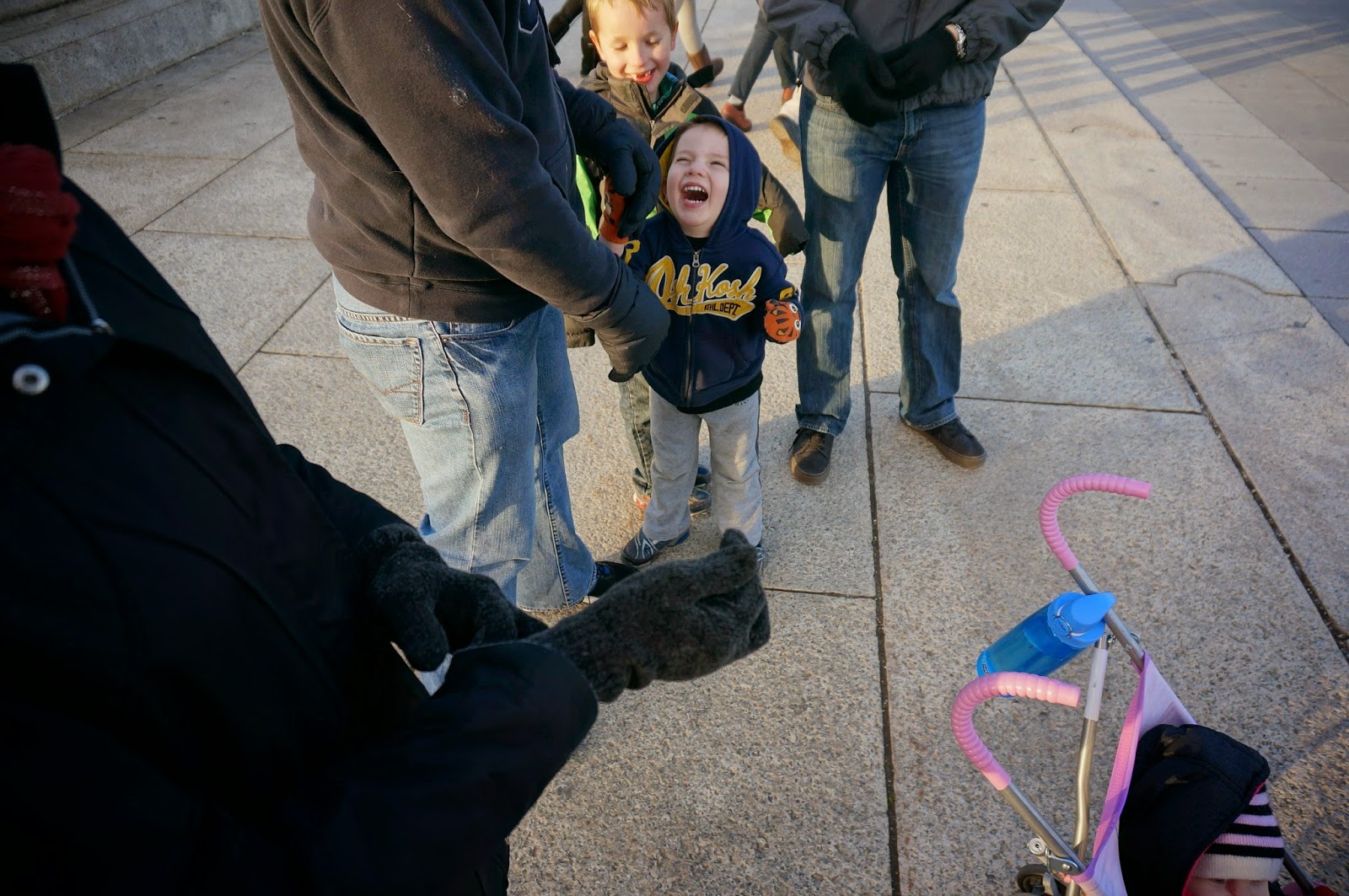
It's important to teach kids about selfies at a young age.


After the parade and lunch (I brought little cherry tarts to share), we went to the Washington Monument to fly kites.  The kites had to be assembled, so we were fortunate that we had enough adults to be paired with each of the kids that were big enough to participate.  That is to say, the assembly was tough, the instructions were vague and unclear, and the wind was aggressive (look at the flags in the background).  We kept at it and everyone got at least a little air time.


 Sophie got plenty of attention later when I held her hand and helped her walk around.

 That kite in air was one of ours!


Clara, flying her kite as high as she could.

After we achieved as much lift as we could manage, we went to the National Museum of the American Indian (which was clearly named quite some time ago) and wouldn't you know it?  They were putting on a presentation of a traditional Cherokee dance.  For those of you keeping track at home, my generation is 1/16th Cherokee and the generation after is 1/32nd Cherokee.  No, it's not a lot of a connection, but it's more than any other tribe, so it was nice to get to learn a little bit more of that heritage.

Once that was done with, we realized that it was getting late and that we needed to part ways.  We tried to get a picture with Margot, Ian, and I, but the first spot we tried didn't have very good lighting.

Yes, I am the youngest person in this picture.

The next spot we tried still had lousy lighting:

Look how patriotic we are with our coordinated shirt colors!

Finally, we found a good spot:

Bryan told us to do a serious picture. Looks like one of us has trouble following directions.

When did Ian start smiling in pictures again?

Margot's expression makes me think a joke was just told, but I don't remember anything. 

Apparently, the joke was in poor taste. 

... really poor taste.

That was our Saturday.  You can't see my sunburn in any of the pictures, but I certainly felt it by the evening.  Even so, it was worth getting cooked a little to get to see my family and spend time with them.

Monday, January 5, 2015

The Ugly Side of America

Samuel experienced his first real encounter with racism recently.  At the job he was working at, he was berated by his boss for talking back (he was trying to explain something that he did, but it was seen as back-talk).  Some of his coworkers told him that he was mistreated because the white manager always talks differently to the minority employees.  They told him that the best tactic is to simply agree to avoid conflict.

Samuel came home angry, but mostly confused.  He told me that in his native country, people judge others based on where they are from or what family they are a part of, but not because of how they look.  Plus, he told me that he thinks of me as his brother and I've never treated him differently simply because he's from Africa, so he just assumed that all people thought the same.  That is to say, some people are good and others are bad, but you judge them by what's in their heart rather than the color of their skin.  His bigoted boss was a real shock.

I am saddened that Samuel had to experience something as terrible as racism and that it took coming to the US to see it firsthand.  However, the restaurant he was working at has closed down, so he won't have to deal with that pig-headed boss.  Not only that, but he's already lined up his next job, this one run by a member of the ward, which almost certainly means that he won't see racism like he so recently did.

Again, I'm really disappointed that Samuel had to go through what he did, but I'm happy that I was able to be a good example and proof that just because one white person is a bigoted creep, not all of us are.

Wednesday, December 3, 2014

Thanksgiving 2014

I'm going to do something different this time and just let some pictures speak for themselves.  So, sit back and enjoy some visual proof that I had a great Thanksgiving and a Black Friday spent at the best mall there is: the National Mall.


I hope that everyone had a happy Thanksgiving.

Friday, November 14, 2014

Cultural Divide

Yesterday evening, when Samuel got home from work, I greeted him and asked him how he was doing. His reply was a simple "good."  When I asked how his work day went, he again went the simple route: "busy."

I was preparing my dinner, so I was happy to keep our conversation brief, but I made a few comments about how a busy day can make the work day go faster.  He then brought up that he had had an awkward encounter with his manager.  On his lunch break, Samuel stepped outside to call his wife to find out about a court appearance that she made on his behalf (he needs to get some documents to help his immigration case in the US, so she was appearing in court to obtain the documents).  Unfortunately, she missed the appearance.  In Nigerian culture, when someone shows you disrespect, it is normal to shout and berate that person until they are more respectful, which is exactly what Samuel did when talking to his wife.  His manager overheard Samuel shouting in Yoruba and asked what happened.  When Samuel explained, the manager was not very understanding and made some comments about how Samuel was being abusive.  (By the way, they were able to schedule another court appearance for today, so everything should be fine.)

Hearing Samuel's story - and knowing a little bit more about his culture than the average American - I suggested that he try to not be so public with his personal issues, not because he was wrong, but because his actions could be misinterpreted.

From the other side of things, Samuel expressed his frustrations with someone that he met soon after moving to Maryland.  A member of our ward asked Samuel a lot of questions about his situation, so he went into great detail about what he was going through.  The member offered his condolences and went on his way.  To Samuel, a person would only ask personal questions if they were willing to offer help - either financial or emotional.  So when he shared such deeply intimate things, he was shocked to get little more than a "that's too bad."

And that's when Samuel starting learning more about American culture.  We tend to be friendly with one another, even to people that we just meet, but we ask personal questions as a way to get to know each other.  And if you think about it, that's pretty weird.  I mean, yeah, it makes sense to ask questions to get to know someone better, but doesn't it make more sense to make small talk about general topics ("You catch the game last night?") rather than more personal stuff ("I see you're wearing a wedding ring; got any kids?")?  Another problem is that when we ask these sorts of questions, we're not expecting the person to air their dirty laundry.  If you greet someone by asking them "How're you doing?", and they answer with anything other than a positive response, it feels super awkward.  You probably think that they're being rude by complaining, while they probably think that they're just being honest.

I expressed to Samuel that I am very careful about who I talk to about my own situation.  For example, it is mostly well known in my ward that I'm married but separated, but other than the Bishop, only two people know more than that.  Occasionally, someone will ask for more detail as to why we're separated (which I see as ridiculously rude), but I'll only ever give a vague answer like "it's complicated."

Samuel seems to be gaining a better understanding American culture (really, greater Baltimore-area culture), it's just unfortunate that a lot of his lessons are learned by making faux pas.  Hopefully that just means that the lessons will stick.

Friday, August 8, 2014

Asking the Right Questions

Samuel has been working part-time as a dishwasher ever since he got his work visa.  He is qualified for better work, but he hasn't had any luck find something else within walking distance, so he's still a dishwasher.  Since starting work there, he's complained about how the managers haven't paid him all of his wages yet.  I told him that he would need to review his pay stub before he complained to anyone, to make sure that he had a claim to make, but I encouraged him to confront the managers to make sure that he gets paid everything he's earned.

As it turns out, Samuel didn't understand how earning an hourly wage works.  He's explained to me that in his homeland, everyone is paid a salary.  When you start work, they tell you how much you'll make each week and cut you a check for that amount.  I thought I had explained the basics to him (and how for a labor-intensive job like washing dishes, earning a wage is actually better than a salary), but I apparently was still making some assumptions about what he knew.  The idea that he wouldn't get paid for his thirty minute break was brand new to him and one of the reasons that he kept complaining that "they don't pay me!"  The bigger issue, however, was that he didn't understand the delay between a pay period ending and actually being paid.  Once I saw that missing piece it was easy to explain that every business needs time to process the hours worked and take out the right amount of taxes.  He saw that hours were missing from his paycheck and couldn't understand why he was being told that they would carry over to the next check.  He simply saw it as an excuse to not pay him.

Living with someone from a foreign country has been an interesting exercise in communication.  I can't use idioms and I try to cut down on using slang (though, like a true Californian, I never stop saying "dude").  On top of that, I just learned that when I think I've explained something thoroughly, I may have left out some vital piece of information.  Even so, I have it easy: Samuel has an even tougher time recognizing when he misunderstands a situation, so I do my best to help out where I can.

Friday, July 4, 2014

A Day of Independence

On Sunday, the Ward Choir sang our nation's anthem.  While that's not particularly special, I realized during our performance that when we sing only the first verse, we're really doing ourselves and our great country a disservice.  The first verse ends with trepidation, not knowing if the USA will survive the War of 1812.  By the final verse, however, we proudly proclaim that no only are we strong but we have God on our side.  It's really a beautiful song, inspiring feelings of patriotism, jingoism, and national pride.


Happy Independence Day!

Friday, July 5, 2013

Gettysburg

Yesterday, to celebrate Independence Day, Ian, Amanda, Clara, Henry, and I visited Gettysburg, Pennsylvania.  I was a bit of a drive to get there, but it was certainly a worthwhile trip.  The entire area was beautiful, with rolling hills and lots of greenery.  The memorials were well crafted, beautiful, and numerous.  Henry in particular kept pointing at the next memorial, usually with a statue on top and declaring that "I want to go there!"  One thing that I appreciated about the trip was seeing the actual numbers of lives lost in the battle of Gettysburg, often carved into granite or written on a plaque and prominently displayed on the memorials.

All parts of the memorials were established as a reminder that our freedom isn't free.  Over the centuries since the United States was founded, millions of men and women have sacrificed themselves to protect the liberties that we enjoy.  Gettysburg was an unfortunate battle, but a necessary one, in that it was a part of the Union Forces to not only end slavery once and for all, but to also keep the country together as one.  What better way to celebrate Independence Day than to be so strongly reminded of that?